The Story of a Winter Festival: How Christmas Came to Be!
- Aslam Abdullah
- Dec 25, 2025
- 6 min read

Updated: Mar 11
On a cold winter evening, when the sky turns dark early and the air feels still, lights begin to glow in windows. Streets shine with color. Songs float through stores and homes. Children wait, adults gather, and families pause their busy lives to remember something special. This season is called Christmas. But the story of Christmas is much older—and more complicated—than many people realize. It is a story that begins not with decorations or gifts, but with questions. When was Jesus born? Did his earliest followers celebrate his birthday? And why did Christmas become a winter festival when the Bible never gives a date? To understand Christmas, we must travel back in time—past trees and candles, past cards and carols—back to the earliest days of Christianity and even before.
A Time Before Christmas
When Jesus lived in the land of Judea about two thousand years ago, there was no Christmas. Jesus himself never celebrated his birthday, and neither did his disciples. This may seem surprising today, because birthdays feel important to us. But in the ancient Jewish world, birthdays were not celebrated, especially for religious teachers. What mattered was how a person lived and what they taught—not the day they were born. Jesus’ earliest followers were Jews. They prayed in simple ways. They gathered quietly. Furthermore, they told stories about Jesus’ teachings, his kindness, and his message of justice and love. Most of all, they remembered his death and believed in his resurrection. The most important Christian celebration was Easter, not Christmas. Easter marked hope, sacrifice, and new life. For the first few hundred years, Christians focused on that event alone. No Christmas trees. No December celebrations. No birthday feast for Jesus.
Christians in a Dangerous World
Early Christians lived in a dangerous time. The Roman Empire ruled much of the known world, and Christians were a small, misunderstood group. They were sometimes blamed for disasters, mocked for their beliefs, or even punished. Because of this, early Christians avoided large public celebrations. They did not want attention. Their faith was practiced quietly—in homes, in small gatherings, often in secret. Big festivals, parades, and feasts were things the Romans loved, but Christians avoided them. Many Roman festivals honored gods the Christians did not believe in. For early Christians, faith was not about festivals—it was about survival.
The Roman Winter Festivals
While Christians stayed quiet, the Roman world celebrated loudly. In December, Romans held joyful winter festivals. The most famous was called Saturnalia. During Saturnalia, people exchanged gifts, decorated their homes, lit candles, shared meals with masters and servants, and relaxed the usual rules of society. It was a time of laughter and light during the darkest days of the year.
Another Roman celebration honored the sun. Around the winter solstice—the shortest day of the year—Romans celebrated the return of light. They believed the sun was being “reborn” as days slowly grew longer again. For the Romans, winter was not just cold. It was symbolic. Darkness meant fear. Light meant hope.
A Changing World
In the early 300s CE, something remarkable happened. Christianity, once illegal, became accepted—and then supported—by the Roman Empire. This changed everything. Christians were no longer hiding. Churches were built. Leaders organized teachings. A calendar of religious events began to form. Now Christians faced a new challenge. If Christianity was going to guide millions of people, it needed shared celebrations. People wanted festivals. They wanted joy, music, and meaning. But when should Christians celebrate the birth of Jesus? No one knew the date.
Choosing a Date Without a Birthday
The Bible does not say when Jesus was born. There is no month. No day. No season mentioned clearly. Some early thinkers tried to guess. Others said it did not matter. But church leaders realized something important: people already celebrated in winter. December was already filled with light, hope, and celebration. Instead of trying to erase those traditions, church leaders chose a different path. They decided to transform them. They chose December 25 as the day to remember Jesus’ birth—not because they believed he was born then, but because the date carried meaning. Darkness was strongest in winter. Light was returning. Christians began to say: “Jesus is the Light of the World.”
A Festival Is Born
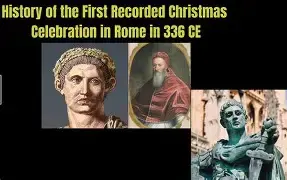
By the mid-300s CE, Christians in Rome began celebrating the birth of Jesus on December 25. This new celebration slowly spread across the empire. Old ideas were given new meanings. Candles became symbols of Christ’s light. Evergreen plants symbolize life that never dies. Feasts became gatherings of gratitude, and gift-giving became a reminder of kindness. What had once honored Roman gods now honored Christian beliefs. This is how Christmas began—not all at once, but slowly, gently, over many years.
Was Jesus Born in December?
Most historians say probably not. The Bible mentions shepherds watching their flocks at night. In the region where Jesus was born, this usually happened in warmer months. Travel during winter was difficult. Roads were muddy. The weather was harsh. Many scholars believe Jesus was more likely born in the spring or early autumn. But for early Christians, the exact date mattered less than the message. Christmas was not meant to be a birthday party. It was meant to be a symbol.
Christmas Grows and Changes
As centuries passed, Christmas changed again. Different cultures added their own traditions: In Northern Europe, evergreen trees were brought indoors. In medieval towns, plays told the story of Jesus’ birth. In later centuries, songs, cards, and stories were created. Some traditions were religious. Others were cultural.
By the time Christmas reached the modern world, it had become a festival of many layers: Faith, Family, Kindness, Memory, and Hope. Christmas became a mirror. Each generation saw in it what they needed most.
What Christmas Teaches Us About History
Christmas shows us something important about how traditions are made. Traditions do not fall from the sky fully formed. They grow. They adapt. Furthermore, they change with time. This does not make them false. It makes them human. Christmas reminds us that people throughout history have sought light in dark times. Whether through candles, stories, or songs, humans have always tried to turn winter into a season of hope.
A Festival of Meaning
Today, people celebrate Christmas in many ways. Some focus on faith. Some focus on family. Some focus on generosity. Some enjoy the warmth of togetherness. Knowing the history of Christmas does not take away its beauty. Instead, it helps us understand it more deeply. Christmas is not just about a date. It is about a message. That even in the darkest season, light returns. That kindness matters. That hope can be shared. And that long ago, people chose to remember these ideas—not in spring or summer, but in winter—when they were needed most.
A Final Thought for Young Readers
When you see lights glowing in December, remember this: you are looking at a tradition that has stood for centuries—a festival shaped by history, belief, and human longing. Christmas is not only about the past. It is about how people, again and again, choose hope over fear. And that choice—more than any date—is what keeps the festival alive.
Bibliography
Brown, Raymond E. The Birth of the Messiah: A Commentary on the Infancy Narratives in the Gospels of Matthew and Luke. New York: Doubleday, 1993.
Chadwick, Henry. The Early Church. Revised Edition. London: Penguin Books, 1993.
Dodds, E. R. Pagan and Christian in an Age of Anxiety: Some Aspects of Religious Experience from Marcus Aurelius to Constantine. Cambridge: Cambridge University Press, 1965.
Ehrman, Bart D. The Triumph of Christianity: How a Forbidden Religion Swept the World. New York: Simon & Schuster, 2018.
Flanders, Judith. Christmas: A Biography. New York: Thomas Dunne Books, 2017.
Forbes, Bruce David. Christmas: A Candid History. Berkeley: University of California Press, 2007.
Jeffers, James S. The Greco-Roman World of the New Testament Era: Exploring the Background of Early Christianity. Downers Grove, IL: InterVarsity Press, 1999.
Jones, A. H. M. Constantine and the Conversion of Europe. Toronto: University of Toronto Press, 2003.
Kelly, Joseph F. The Origins of Christmas. Collegeville, MN: Liturgical Press, 2004.
Macrobius. Saturnalia. Translated by Percival Vaughan Davies. New York: Columbia University Press, 1969.
Moore, George Foot. Judaism in the First Centuries of the Christian Era: The Age of the Tannaim. Cambridge, MA: Harvard University Press, 1927.
Nissenbaum, Stephen. The Battle for Christmas: A Cultural History of America’s Most Cherished Holiday. New York: Vintage Books, 1997.
Safrai, Shmuel, and Menahem Stern, eds. The Jewish People in the First Century: Historical Geography, Political History, Social, Cultural and Religious Life and Institutions. Philadelphia: Fortress Press, 1976.
Talley, Thomas J. The Origins of the Liturgical Year. Collegeville, MN: Liturgical Press, 1991.
Wainwright, Geoffrey, and Karen B. Westerfield Tucker, eds. The Oxford History of Christian Worship. Oxford: Oxford University Press, 2006.


Nicely explained about celebrating Christmas. No Muslim scholar has explained when and why it was celebrated. Great knowledge and article. Keep it up. May we get to gain more knowledge from you
Dr. Talat Khan
Great informative article