What led the Terrorists to kill Muslims at the San Diego Masjid


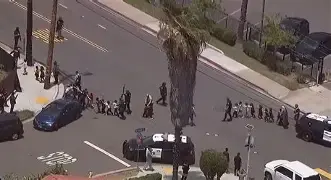
The tragic attack on the Islamic Center of San Diego on May 18, 2026, has shaken Muslim communities across the United States and deeply disturbed all people of conscience. According to police reports, three worshippers, including a security guard, were killed before the two teenage suspects — aged seventeen and nineteen — died from apparent self-inflicted gunshot wounds nearby. Authorities are investigating the assault as a possible hate crime, and anti-Muslim writings were reportedly discovered in the suspects’ vehicle and on one of the firearms used in the attack. The nation will understandably ask who these young men were. Investigators will examine their families, online activity, social circles, psychological condition, ideological influences, and possible extremist connections. They will search through digital histories, private messages, manifestos, and social media trails. Those investigations are necessary. But they are not enough.
The deeper question is far more unsettling: Who taught them to hate? Hatred does not emerge in a vacuum. Violence is rarely born in a single moment. Before bullets are fired, minds are prepared. Before mosques are attacked, human beings are slowly conditioned to see other human beings as threats, enemies, invaders, or less deserving of dignity and safety. That conditioning can come from many places. Sometimes it grows within broken homes filled with anger and alienation. Sometimes it spreads through peer groups, online forums, extremist subcultures, or isolated digital communities that normalize violence. Sometimes it is nourished by political rhetoric, sensationalist media narratives, conspiracy theories, or ideological movements that repeatedly portray Muslims as dangerous outsiders.

The investigation may eventually reveal precisely what influenced these teenagers. But regardless of the final findings, one reality can no longer be denied: Islamophobia has become one of the most normalized forms of public hatred in contemporary discourse.
For years, Muslims in America have been subjected to relentless suspicion and demonization. Political figures, media personalities, and extremist movements have repeatedly framed Islam not as a faith practiced by millions of ordinary human beings, but as a civilizational threat. Entire communities have been judged collectively for global conflicts, geopolitical anxieties, and ideological fears. In recent years, the climate has intensified further because of fierce debates surrounding Palestine, opposition to war, criticism of Israeli government policies, and rising global polarization. In some circles, even expressing concern for Palestinian civilians has been enough to invite accusations, hostility, harassment, or public demonization. Online propaganda ecosystems — including some extremist Zionist, Christian nationalist, white supremacist, and Hindutva-oriented networks — have contributed to an atmosphere where Muslims are increasingly portrayed as enemies within. This rhetoric may differ in language and political framing, but it often converges around the same dangerous outcome: the dehumanization of Muslims.

None of these excuses murder. Personal responsibility remains absolute. The individuals who carried out this atrocity alone bear responsibility for their actions. But societies must also confront the environments that normalize hatred before hatred turns deadly. History repeatedly teaches the same lesson: hatred never remains confined to one community. When prejudice is tolerated against Muslims, it does not stop with Muslims. The same forces of fear and dehumanization eventually target Jews, Black communities, immigrants, Asians, Christians, Hindus, Sikhs, political opponents, or anyone portrayed as “other.” America has already witnessed this cycle repeatedly — from attacks on synagogues in Pittsburgh and Poway to violence against churches, temples, Black neighborhoods, and immigrant communities. Hatred spreads like a forest fire. Once ignited, it becomes difficult to control. And when societies normalize the language of collective blame, conspiracy, and demonization, no one remains truly safe.
The murder of worshippers inside or near a mosque is not only an attack on Muslims. It is an attack on the moral fabric of society itself. Houses of worship represent humanity at its most vulnerable — places where people gather seeking peace, prayer, reflection, and connection with God. To violate such a space is to violate something sacred within human civilization. The response to this tragedy, therefore, cannot be limited to police investigations alone. It requires moral introspection. Religious leaders, educators, journalists, politicians, technology platforms, and communities themselves must ask difficult questions about the culture being created around young people.
What language are they hearing daily? What fears are being fed to them? What prejudices are being normalized? What forms of hatred are being rewarded with applause, ratings, clicks, or political advantage? The future safety of all communities depends upon whether society has the courage to confront those questions honestly. At moments like this, mourning alone is not enough. The dead deserve justice. The living deserve protection. And future generations deserve a society in which disagreement does not evolve into dehumanization, and dehumanization does not evolve into bloodshed.


I , as an American, has the responsibility to inform all Amrericans about Islamophobia. All the talking points are given in your article. Thank you for this article.
I will send it to as many people as possible.
Mohammad Yacoob
May God protect all innocent souls and make us Muslims from the promoters of mercy and peace.