A Muslim Won in Michigan. The Constitution Won in America.


Abdul El-Sayed's Historic Victory Is Not About One Faith, One Ethnicity, or One Community—It Is About the Promise of American Democracy
By Dr. Aslam Abdullah
Americans have always taken pride in the electoral achievements of people who share their religion, ethnicity, language, or cultural heritage. Irish Americans celebrated the election of John F. Kennedy, the nation's first Catholic president. African Americans celebrated Barack Obama's historic presidency. Jewish Americans have welcomed the success of Jewish candidates. Hispanic, Asian, and other communities have similarly rejoiced when one of their own has broken a political barrier. Such celebrations are not inherently divisive. They reflect the human desire for recognition, belonging, and participation in national life.
Abdul El-Sayed's election to the United States Senate from Michigan deserves to be understood in this historical context. He is the first Muslim elected to the Senate, an achievement that carries special meaning in a country where Christianity remains the majority religion. But his victory belongs to more than Muslim Americans. It belongs to the democratic system that made his election possible.
The Demographic Reality of American Democracy
America is a Christian-majority country, but it is not constitutionally a Christian nation. Its constitutional framework establishes religious freedom and prohibits religious tests for public office. According to the Pew Research Center's 2023–2024 Religious Landscape Study, approximately 62 percent of American adults identify as Christian. About 29 percent are religiously unaffiliated, while Muslims constitute approximately 1.2 percent, Jews 1.7 percent, Buddhists 1.1 percent, and Hindus 0.9 percent.
Congress has historically been considerably more Christian than the population it represents.
At the start of the 119th Congress in January 2025, Pew Research Center recorded 461 Christian members, about 87 percent of the 532 lawmakers in its religious-affiliation analysis. Among them were 295 Protestants and 150 Catholics.
The same analysis identified 32 Jewish members, four Muslims, four Hindus, three Buddhists, and members belonging to other religious or nonreligious traditions.
The contrast between the two chambers was particularly revealing. All four Muslim members were in the House of Representatives. None served in the Senate. The Senate included nine Jewish members and one Buddhist among its non-Christian religious representatives.
El-Sayed's election on November 3, 2026, therefore breaks a barrier that had survived more than two centuries of American constitutional government. When the new Congress convenes in January 2027, his presence will represent another step toward religious diversity in the nation's highest legislative institutions.
Ethnic representation tells a similar story.
The 119th Congress began with 139 voting members identifying as Black, Hispanic, Asian American, or Native American—approximately 26 percent of Congress. The House was 28 percent racially or ethnically diverse, compared with 16 percent of the Senate.
At that time, the Senate included five Black members, seven Hispanic members, three Asian American members, and one Native American member. Yet racial and ethnic minorities represented approximately 42 percent of the American population. Non-Hispanic White Americans accounted for approximately 58 percent of the population but 74 percent of Congress. These figures show both the progress America has made and the distance it still has to travel. They also establish an important principle: representation becomes more inclusive when citizens from historically excluded communities can compete for office, while every elected official remains responsible to the entire constituency.

The Meaning of El-Sayed's Victory
Abdul El-Sayed is the son of Egyptian immigrants. He is a Muslim, a physician, a public-health advocate, and an American citizen. His religion is part of his personal identity. His ancestry is part of his family history. Neither defines the constitutional limits of his responsibilities. His victory speech appropriately reflected pride in his background. By introducing himself by his full name and publicly thanking God, he showed that an American politician need not conceal his religious identity to participate in public life.
But it would be a serious mistake to interpret his election primarily as a mandate to represent Muslim interests.
He was not elected exclusively to defend Muslims in America, Palestinians in Gaza, Kashmiris, or Muslims in India. Nor was he elected to represent Egyptian Americans alone.
Michigan voters elected him to serve the people of Michigan in the United States Senate and to fulfill the constitutional responsibilities of that office.
That distinction is fundamental. A Jewish senator is not elected to defend Israel. A Catholic senator is not elected to represent the Vatican. A Hindu representative is not elected to defend India. A Protestant legislator is not elected to advance the interests of one Christian denomination. Their personal identities may inform their moral perspectives, but their public responsibilities arise from the Constitution and the interests of the people they represent. The same principle applies to Abdul El-Sayed.
Loyalty to the Constitution, Not to Religious Identity
Article VI of the United States Constitution explicitly prohibits religious tests as qualifications for public office. The First Amendment protects freedom of religion and prohibits the federal government from establishing an official religion. These protections are not favors granted by a religious majority. They are constitutional guarantees of equal citizenship.
When El-Sayed takes his oath as a senator, he will swear to support and defend the Constitution of the United States. He will not swear allegiance to a mosque, a religious organization, an ethnic community, or a foreign nation. His election demonstrates that these constitutional principles can operate even when a candidate belongs to a small religious minority. This is an important lesson for Americans of every faith and for those who profess no religion. The American constitutional system does not require a Muslim to become less Muslim, a Jew to become less Jewish, or a Christian to become less Christian to hold public office. It requires public officials to distinguish between their personal convictions and their responsibilities under the law. Religious identity should neither disqualify a candidate nor grant that candidate exemption from public scrutiny. Accountability standards must apply equally to everyone.
American Interests Must Remain Central
El-Sayed has advocated affordable healthcare, economic justice, reduced corporate influence in politics, and greater accountability in government. These policies should be examined on their merits, their costs, and their effects on the American people—not through assumptions about his religion. His responsibility will be to defend constitutional liberties, promote public welfare, protect democratic institutions, and evaluate national and international issues according to American law, legitimate national interests, and universal principles of human dignity. He can oppose injustice in Palestine without becoming a representative of Palestine. He can speak against discrimination in India or Kashmir without becoming a spokesman for religious communities abroad. He can likewise defend Jewish Americans from antisemitism, Christians from religious persecution, immigrants from discrimination, and nonbelievers from violations of conscience. The common principle is equal human dignity.
American foreign policy legitimately involves both national interests and international responsibilities. Debates about military spending, humanitarian assistance, diplomatic alliances, and human rights must therefore be conducted through constitutional processes and democratic accountability. The question is not whether a senator has emotional connections to communities beyond America's borders. Many Americans do. The question is whether public decisions are justified through evidence, constitutional principles, and obligations to the country the senator serves.
Pride Must Not Become Political Ownership
The excitement among Muslim Americans following El-Sayed's election is understandable. A community that has frequently faced suspicion now sees a member of its faith entering an institution from which Muslims had previously been absent. That recognition has emotional and historical significance. But celebration must not become political ownership.
Muslim Americans should not expect El-Sayed to act as their exclusive advocate, any more than Christian Americans should expect every Christian legislator to advance denominational interests. His Muslim identity deserves respect. His political decisions deserve evaluation. Indeed, the broader significance of his election lies in the fact that many non-Muslim voters supported him despite attempts to make his faith a political liability. Voters could assess his proposals, qualifications, and campaign without reference to religious identity. This is how constitutional equality acquires practical meaning.
From Historic Representation to Democratic Responsibility
The Declaration of Independence speaks of life, liberty, and the pursuit of happiness. The Constitution establishes the framework through which Americans seek to secure their freedoms, exercise political authority, and govern themselves.
El-Sayed's responsibility is to help translate those ideals into public policies that serve people regardless of their religious beliefs, ancestry, language, or political affiliations.
His election is historically significant, but his performance in office will ultimately determine his public legacy.
Will he protect freedom of expression even for those who criticize him? Will he defend religious liberty for people whose beliefs differ from his own? Will he pursue policies that improve the lives of families who did not vote for him? Will he distinguish legitimate criticism of foreign governments from prejudice against their peoples? These are appropriate questions for every senator, regardless of faith or party. The success of American pluralism cannot be measured simply by the number of minority citizens elected to office. It must also be measured by elected officials' ability to serve a diverse public under common constitutional principles. Abdul El-Sayed's victory offers an opportunity to reaffirm that distinction.
Muslims may celebrate his election because he is Muslim. Egyptian Americans may celebrate because of his ancestry. Progressives may celebrate because of his policies. But Americans across the political and religious spectrum can recognize the constitutional significance of a democratic system in which a citizen's faith is no barrier to elected office.
His identity explains why the victory is historic. The Constitution explains why it was possible.
And his responsibility, now that he has won, is not to serve one religion, one race, or one ancestral homeland, but to uphold the constitutional order and serve the public.
The ultimate triumph will not be that America elected its first Muslim senator. It will be that America judges him, as it should judge every elected official, by his fidelity to the Constitution, his integrity in public service, and the consequences of his policies for the people he represents. That is the promise of American democracy. And that is the responsibility Abdul El-Sayed now inherits.
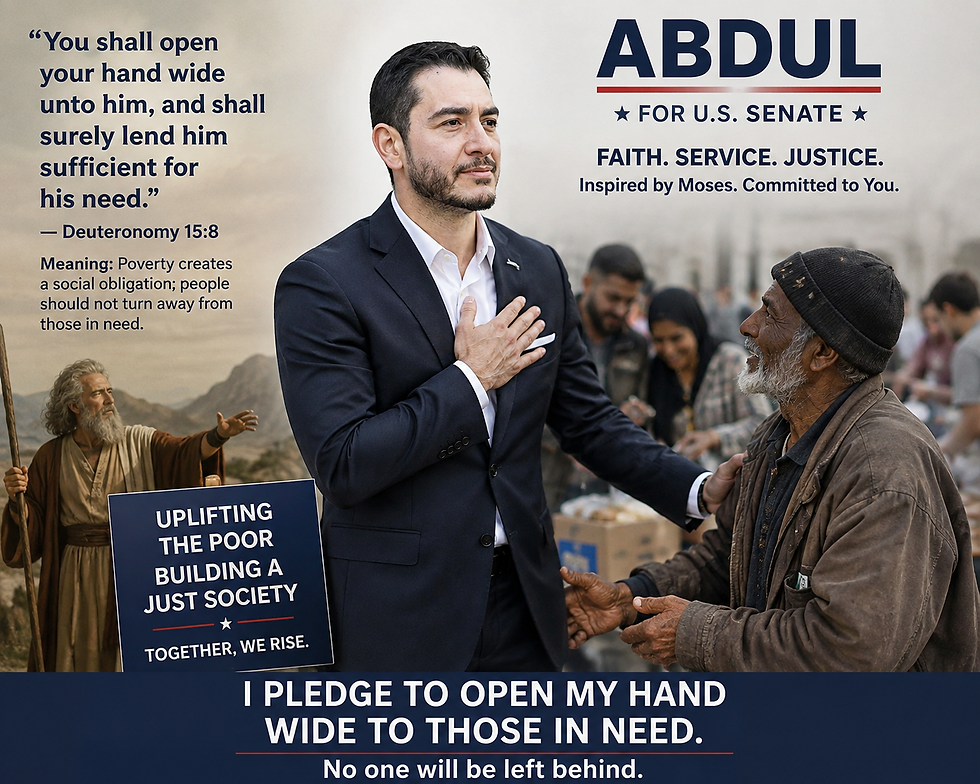


This new generation of young American politicians, especially those of the Muslim faith, is unapologetic, remarkably clear about its vision, firm in its convictions, and highly eloquent.
The midterm elections have restored my faith in democracy. The nation has overwhelmingly rejected the message of hate and division. I salute the American people for upholding high moral standards and rejecting narrow-minded thinking.