The Ideal Muslim Family and the Crisis of the Modern Family: A Qur'anic Vision for Restoring Human Flourishing


Family has always been the first school of humanity. Before a child enters a classroom, joins a community, or becomes a citizen of a nation, he or she first learns what it means to be human within the home. It is there that love is first experienced, trust is first cultivated, values are first transmitted, and faith is first practiced. The health of a civilization, therefore, is inseparable from the health of its families. The Qur'an presents the family not merely as a biological or legal institution, but as a sacred trust (amānah) entrusted by Allah. It is intended to become the primary environment in which faith is nurtured, character is formed, knowledge is transmitted, and compassion becomes a daily habit. Likewise, the Sunnah of the Prophet Muhammad ﷺ—beautifully reflected in Imam al-Bukhari's Al-Adab al-Mufrad—portrays the family as the foundation upon which a just and compassionate society is built. Yet this Qur'anic vision stands in sharp contrast to many of the crises confronting families in the twenty-first century. Across much of the world, including Muslim communities, families are experiencing unprecedented pressures. Rising individualism, economic stress, technological isolation, declining respect for elders, increasing loneliness, fractured marriages, inheritance disputes, and weakening intergenerational relationships have transformed what was once humanity's strongest institution into one of its most vulnerable. The Qur'anic model offers not merely a nostalgic memory of the past but a timeless framework for rebuilding families that nurture both faithful believers and responsible citizens.
The Family as a Divine Trust
The modern world often understands family primarily through the language of rights. Islam begins with responsibilities. Every relationship within the family is an amānah—a trust entrusted by Allah. Marriage is not simply companionship but a covenant (mīthāqan ghalīẓā). Parenthood is stewardship rather than ownership. Children are gifts entrusted for cultivation rather than possessions to be controlled. Aging parents become opportunities for worship rather than burdens to be managed. The Qur'an repeatedly reminds believers: "Worship Allah and associate nothing with Him, and be good to parents, relatives..." (Qur'an 4:36). This verse establishes a hierarchy of moral responsibility that extends beyond the nuclear household to embrace grandparents, siblings, aunts, uncles, cousins, neighbors, and ultimately society itself. Modern societies, by contrast, increasingly define adulthood as independence from family. Success is measured by personal autonomy, financial self-sufficiency, and geographical mobility. While these developments have expanded individual opportunities, they have often weakened the very networks of care that historically protected people during illness, aging, unemployment, and emotional hardship. Islam does not reject independence. Rather, it insists that independence must never come at the expense of interdependence.

Honoring Parents and Grandparents
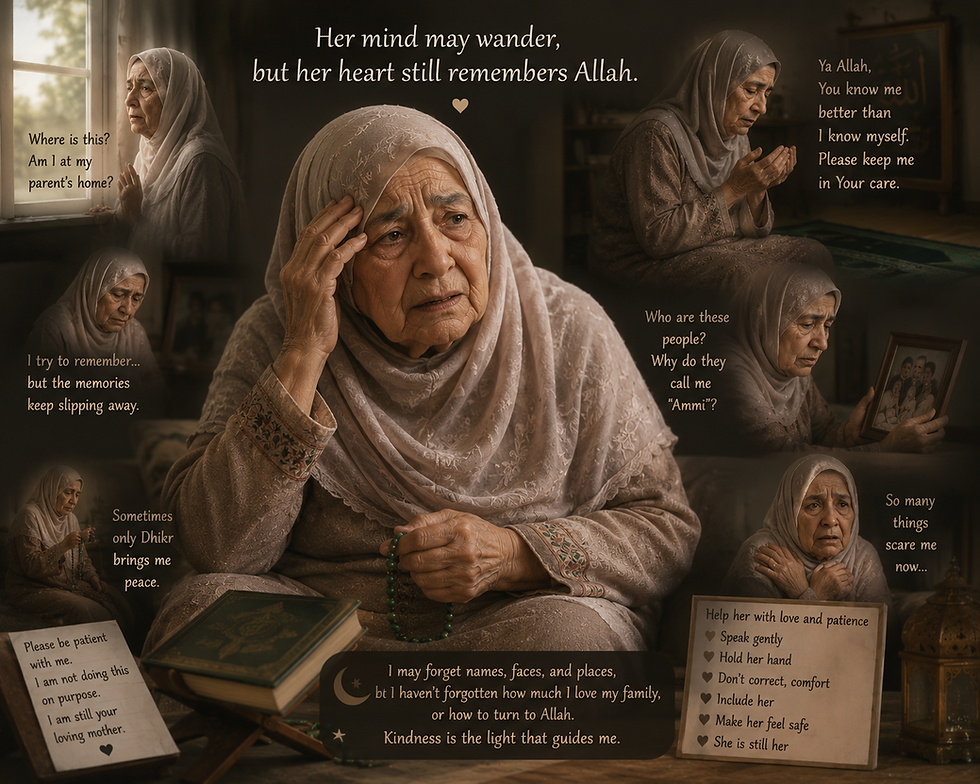
Few changes illustrate the modern family crisis more vividly than the changing place of the elderly. In many societies, aging parents increasingly live alone, separated from their children by careers, distance, or emotional estrangement. Loneliness has become one of the defining illnesses of old age. The Qur'an offers a radically different vision. Parents occupy a sacred position immediately after the worship of Allah. Their care is not simply an ethical obligation but an act of devotion. Grandparents occupy an equally vital role. They are the living memory of the family, preserving stories, transmitting wisdom, and connecting younger generations to their spiritual and cultural heritage. Their presence provides continuity in an age increasingly characterized by fragmentation. Children raised with active relationships with grandparents inherit something impossible to purchase: perspective. They learn patience from those who have endured hardship, gratitude from those who have sacrificed, and resilience from lives lived before the age of convenience. Modern families often deprive themselves of this invaluable inheritance.
The Extended Family as Social Capital
The Qur'an places extraordinary emphasis upon ṣilat al-raḥim—maintaining the bonds of kinship. Uncles and aunts are not distant relatives but extensions of one's parents. Cousins become lifelong companions. Siblings are expected to provide mutual protection and moral support throughout life. Contemporary culture often narrows family to parents and children alone. As a result, families become increasingly isolated. When difficulties arise—illness, divorce, financial hardship, or emotional crisis—fewer relationships are capable of absorbing the shock. Islamic civilization historically built remarkable resilience precisely because responsibility was distributed across extended families. The family became society's first welfare system.
Children: Stewardship Rather Than Ownership

Perhaps nowhere is the difference between Islamic and modern assumptions more apparent than in how children are understood. Modern parenting often oscillates between two extremes. Some parents become excessively controlling, attempting to shape every aspect of their children's future. Others embrace radical permissiveness, believing children should determine their own values with minimal guidance. The Qur'an proposes neither control nor neglect. Children belong to Allah before they belong to their parents. Parents are trustees charged with nurturing intellect, conscience, compassion, emotional maturity, and faith. Success is measured not merely by academic achievement or professional status but by the emergence of individuals who serve humanity with integrity. An ideal Muslim family, therefore, asks not simply: "Will my child become successful?" It asks: "Will my child become beneficial?"
Conflict Without Destruction
Every family experiences disagreement. The question is not whether conflict occurs but how conflict is managed. Modern societies increasingly normalize litigation, permanent estrangement, and emotional severance. Families divide over inheritance. Siblings stop speaking. Parents become isolated. Children become trapped between competing loyalties. The Qur'an offers another path. Its first instinct is reconciliation. Mediation (ḥakam) precedes confrontation. Forgiveness precedes retaliation. Reconciliation is valued above victory. The Prophet ﷺ taught that true strength lies not in overpowering another person but in mastering one's own anger. Within the Qur'anic family, preserving relationships becomes more important than winning arguments. This requires iḥsān—choosing generosity over entitlement. Sometimes preserving family requires voluntarily surrendering one's legal rights for the sake of a greater moral good. Such sacrifices appear irrational within a culture dominated by individual rights but become entirely reasonable within a worldview centered upon accountability before Allah.
The Greatest Battle: The Ego Within
Most families are not destroyed by dramatic external events. They are gradually weakened by internal diseases. Jealousy. Greed. Pride. Suspicion. Material or status competition. The desire is always to be right. The Qur'an repeatedly identifies these qualities as manifestations of the lower self (nafs) and openings through which Shayṭān fractures human relationships. Many inheritance disputes begin not because people need more wealth but because they feel insufficiently recognized. Many family conflicts persist because wounded pride takes precedence over reconciliation. The Qur'an, therefore, directs believers toward the greatest form of leadership: Self-mastery. The believer continually asks: "Is my reaction pleasing Allah, or merely satisfying my ego?" Families capable of asking that question consistently possess extraordinary resilience.
Technology and the Crisis of Presence
One challenge unique to our age deserves particular attention. Families today often live together physically while remaining emotionally absent. Televisions remain on. Phones dominate conversations. Meals become silent. Each family member inhabits a separate digital universe. The Qur'anic family is built upon presence. Conversation. Shared meals. Collective worship. Mutual consultation. Acts of service. Listening. Technology itself is not the enemy. Isolation is. No digital connection can replace a grandparent telling stories, parents making du'ā' with their children, siblings solving problems together, or families gathering around the Qur'an.
Faith Lived in Ordinary Moments
The greatness of the Muslim family does not emerge through extraordinary events. It appears in ordinary habits. Greet one another with warmth. Sharing meals. Serving aging parents. Making du'ā' before beginning work. Reciting the Qur'an together. Visiting relatives. Reconciling before sleeping. Speaking kindly during disagreement. Expressing gratitude. Seeking forgiveness. These seemingly small acts gradually shape souls. Faith becomes visible not through slogans but through character.
Building Families That Build Nations
Strong nations do not emerge from strong economies alone. They emerge from strong families. A society filled with fractured households eventually experiences fractured communities. Conversely, homes built upon justice, mercy, humility, and service naturally produce citizens capable of strengthening schools, neighborhoods, institutions, and governments. The Qur'an, therefore, begins social reform where every civilization begins—with the family. It teaches that public virtue cannot survive without private virtue. The family becomes the first academy of leadership, the first school of ethics, the first sanctuary of compassion, and the first institution of justice.
Conclusion: Recovering the Qur'anic Vision

The crisis confronting modern families is not merely economic or psychological. It is spiritual. Many families possess larger homes than previous generations but spend less meaningful time together. They possess greater wealth yet experience greater loneliness. They enjoy unprecedented technological connection while suffering unprecedented emotional isolation. The Qur'anic vision offers a profound corrective. It reminds us that families flourish when relationships are viewed as trusts rather than transactions, when responsibilities outweigh entitlements, when forgiveness overcomes pride, when service triumphs over selfishness, and when every member of the household understands that love of Allah is expressed through love, mercy, justice, and compassion toward one another. The ideal Muslim family is therefore far more than a successful household. It is a community of worship, a school of character, a sanctuary of mercy, and a training ground for moral leadership. It nurtures individuals whose concern extends beyond themselves to their neighbors, their society, and ultimately the whole of humanity. When families embody the values of the Qur'an and the Sunnah, they become more than stable homes—they become the seeds from which just societies, compassionate communities, and enduring civilizations grow.


Comments